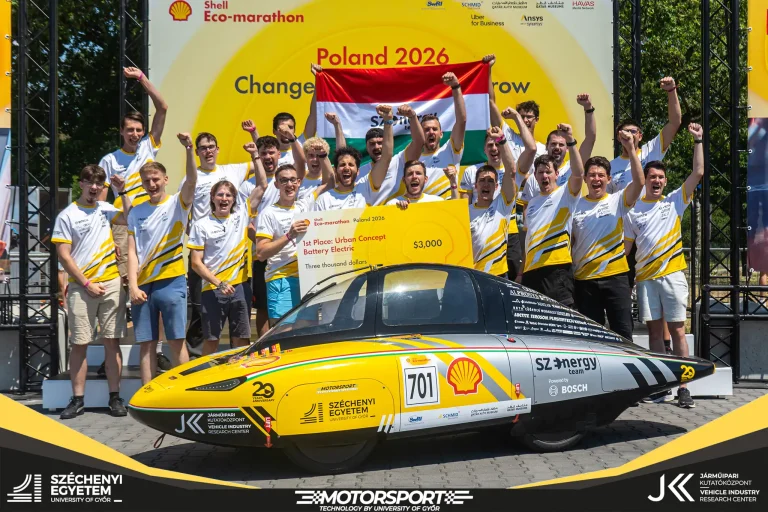
The Shell Eco-marathon is one of the world’s most prestigious energy efficiency competitions, where students from leading universities compete with their self-developed, low-consumption vehicles. The team of Széchenyi István University, SZEnergy Team, has long been a key participant in the competition: since 2022, it has won the electric category every year with a world record. As defending champion, the team arrived at this year’s competition in Poland, held between 24 and 28 June, where it once again outperformed all of its rivals.
This time, the team set a new world record with a result of 332 kilometres per kilowatt-hour, surpassing its own previous record of 327 kilometres per kilowatt-hour from last year. This means that the vehicle named SZEmission completed the designated distance with such low energy consumption that, converted into a comparable figure, it would be capable of travelling 332 kilometres using just one kilowatt-hour of energy — equivalent to the consumption of a 100-watt light bulb running for only ten hours. The value of the victory is further increased by the fact that SZEnergy Team finished ahead of more than twenty teams, including some of Europe’s leading technical universities. Among others, they outperformed teams from the University of Toulouse in France, Politecnico di Milano in Italy, Trier University of Applied Sciences in Germany, the Norwegian University of Science and Technology, the National Technical University of Athens in Greece, Istanbul Technical University in Turkey and Warsaw University of Technology in Poland.
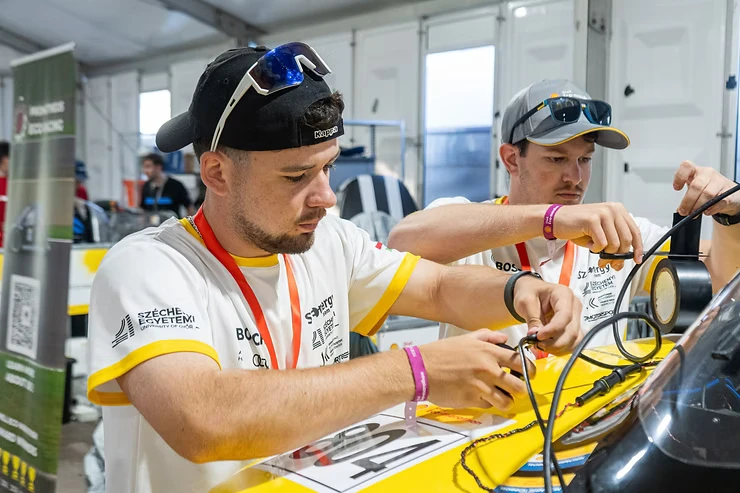
Bence Novák, leader of SZEnergy Team, said: “This year’s competition took place in a shorter format, so we had to start with a competitive run straight away, without any practice opportunity. On our very first run, we achieved a result of 282 kilometres per kilowatt-hour, and it later turned out that this alone would have been enough to win. However, we could see that there was much more potential in the car, so we continuously fine-tuned the settings and tested the systems. On the final day, everything came together, enabling us to achieve the result of 332 kilometres per kilowatt-hour. We are extremely proud of this new world record and victory,” he recalled.
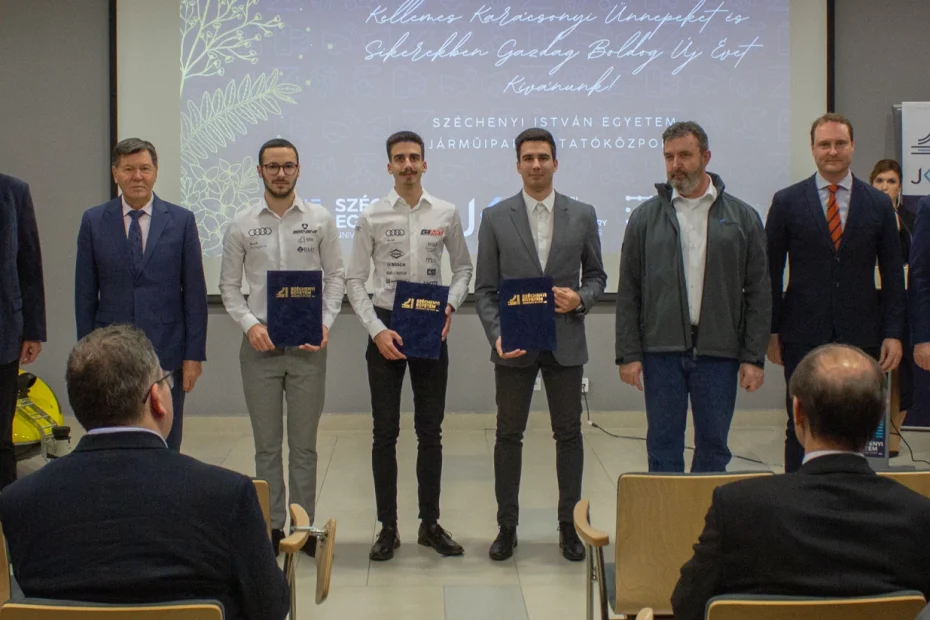
Behind this outstanding result stands the practice-oriented approach of Széchenyi István University and its innovation-supporting environment. SZEnergy Team has long benefited from the support of the university and its Vehicle Industry Research Centre, as well as from its industrial partners. The university also supported the team’s participation in the competition through the Pannonia Scholarship Programme. As a result, the students continue to develop their vehicle year after year, while gaining knowledge and experience that place them among the best in international comparison.

Bence Novák added: “For this year’s competition, we primarily prepared with software developments, which, together with safety-related modifications, significantly contributed to the new record.” The team leader concluded by thanking the university, the partners and sponsors for their support, as well as all team members for their work throughout the year.


Source: Széchenyi István University