It is worth recalling:
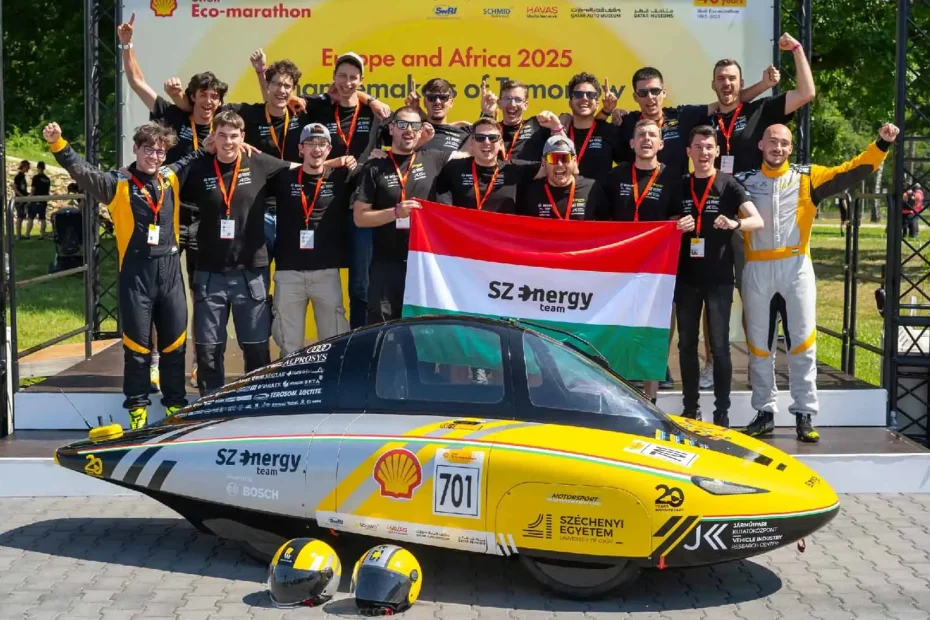
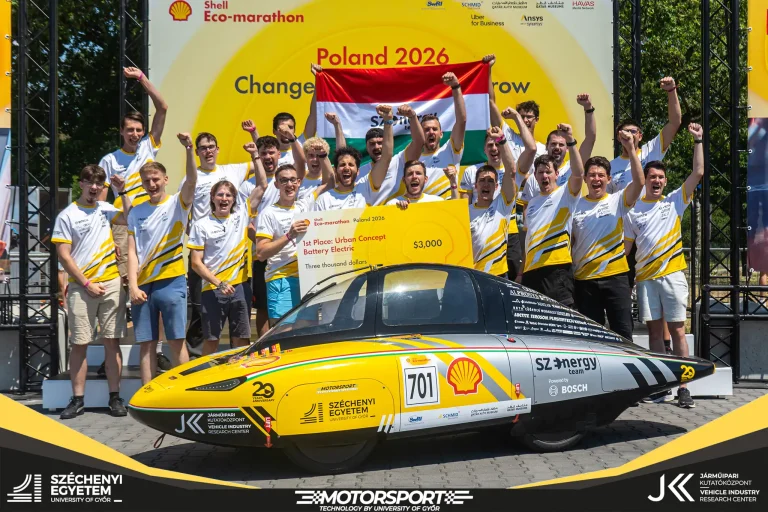
Last year, achieving the greatest success in its history, SZEnergy Team won the Urban Concept category of the Shell Eco-marathon with an almost flawless performance, convincingly beating all of its rivals – including teams from the universities of Munich, Toulouse and Milan.
The result was impressive even on a global scale: no one before them had been able to achieve an energy efficiency of 284 km/kWh. In essence, using the amount of energy required for around two hours of ironing or making 35 cups of tea, the team’s electric vehicle, named SZEmission, could theoretically have covered 284 kilometres at the racetrack near Assen in the Netherlands. (The car did not actually travel 284 kilometres during the competition; this figure represents the proportional energy consumption calculated from the completed runs.)
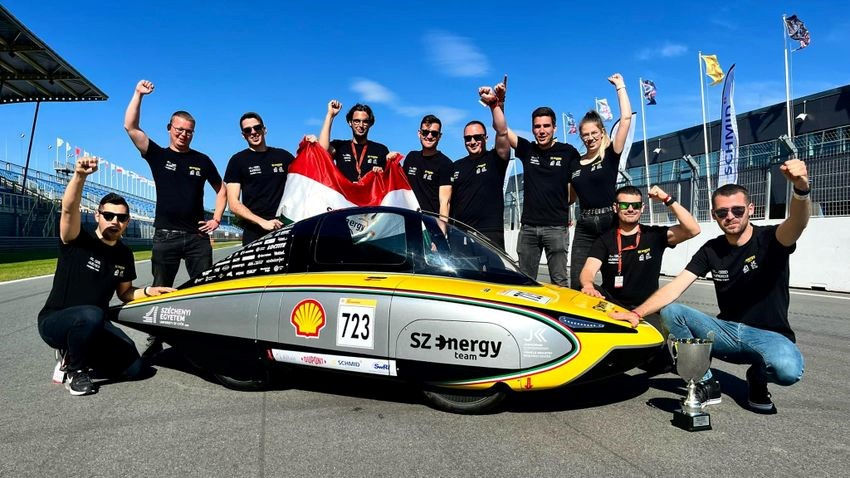
The Széchenyi István University team reached the top after many years of work. Following the discontinuation of the solar category, the team has competed in the Urban Concept category since 2013. The current vehicle first competed in 2019 and was refined over several years before achieving last year’s result. Countless small improvements, optimisation, testing and a great deal of work finally paid off a year ago. But can the team improve even further? And can last year’s outstanding performance be repeated?
Based on last year’s world record, SZEnergy Team is one of the best teams in the world. Of course, this also means that this year we are competing against ourselves, and the biggest challenge is whether we can surpass our own performance.
– said Dr Ferenc Szauter, head of the Vehicle Industry Research Center at Széchenyi István University and a former founding member of the team. He added that following last year’s exceptional performance, the entire field would likely try to reach the benchmark set by SZEnergy Team, making the competition even more intense.
It is clear from this that simply repeating last year’s performance may not be enough to secure victory this year.
The team knew that simply bringing back the world-record car unchanged would not be enough, so from the very beginning of the preparation period they focused on further developments in order to maintain their competitiveness.
Keeping the championship-winning car unchanged was not an option for another reason either: SZEnergy Team is a student team, and its primary purpose is not simply to achieve results but to train the next generation of professionals. At Széchenyi István University, young engineering students gain practical experience similar to real industrial projects through designing, building and racing the car. For this reason, it is important to introduce something new to the vehicle every year. This year was no exception, and changes to the regulations also required several modifications.
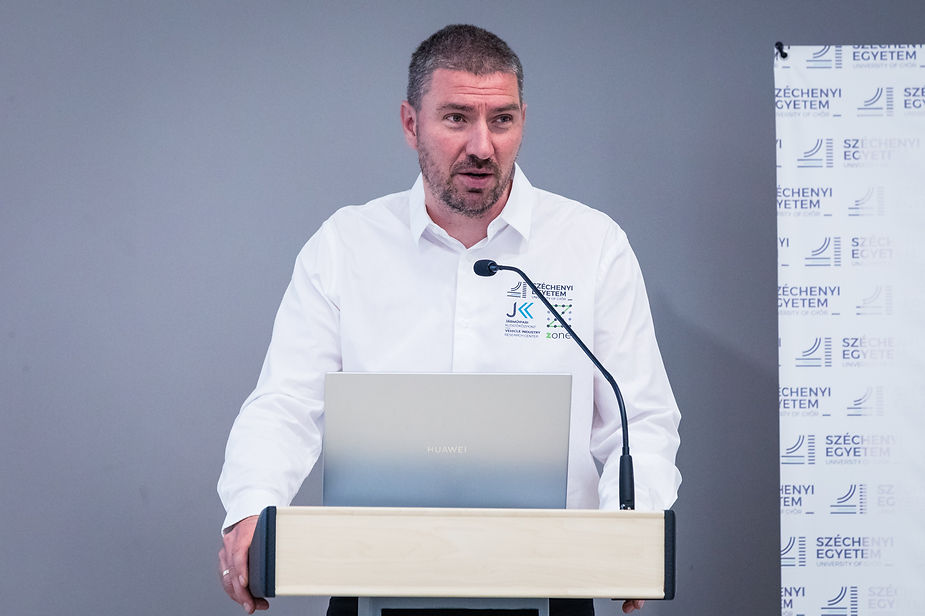
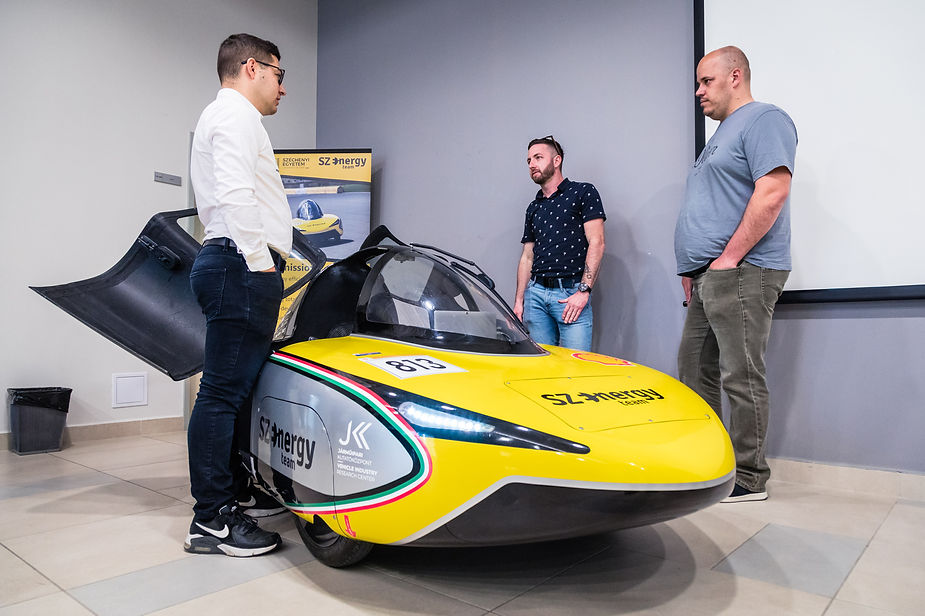
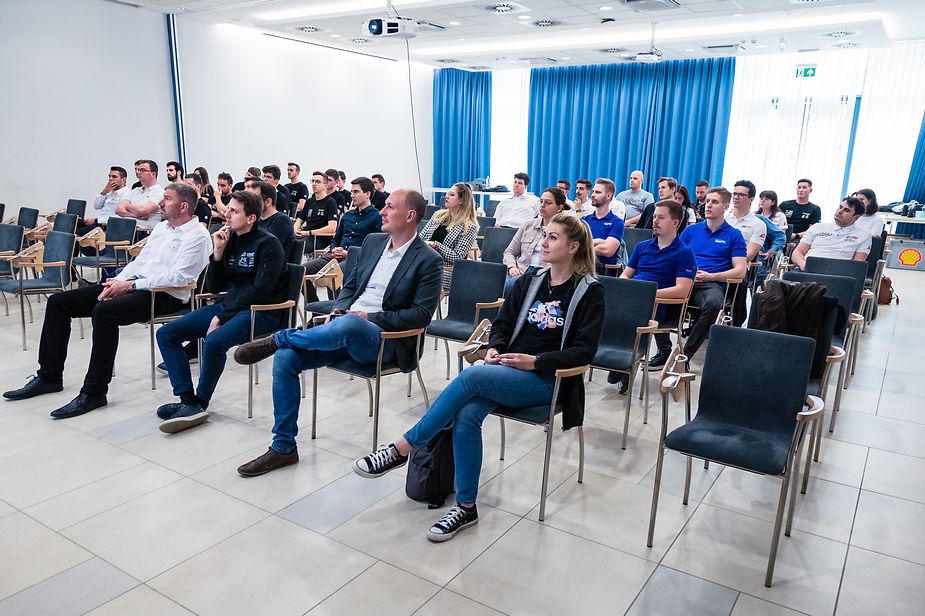
The team first revealed its plans for this year at the winter design freeze event. Now, as the final milestone before the competitions, the team presented this year’s vehicle and reported on the results of its development work. In engineering competition teams, this event is known as the rollout, marking the end of the building and testing phase before the start of actual competition.
Traditionally, the team presents its development directions for the year at a closed event attended by sponsors, invited guests and members of the press.
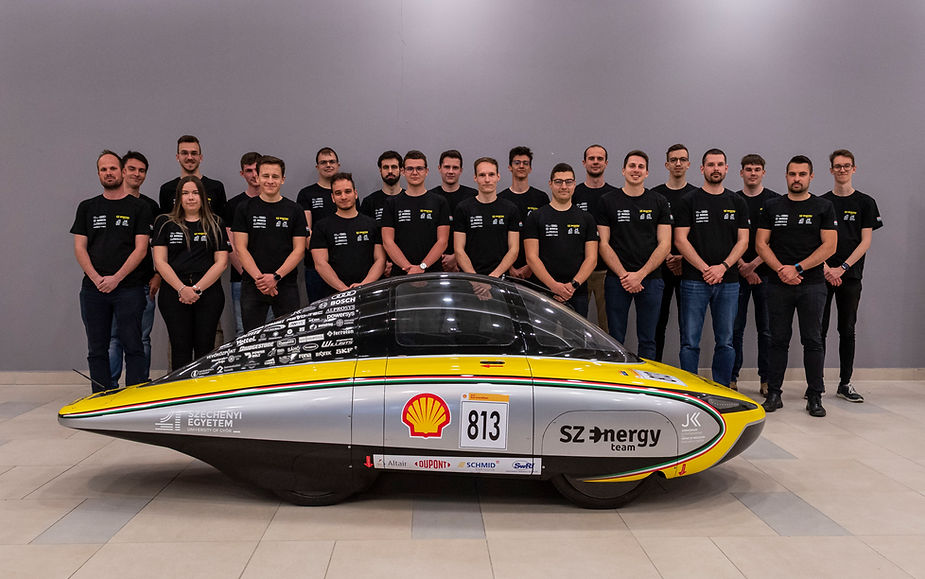
This year we will participate in two competitions, which will be held one after another and partly in parallel in Nogaro, France. From 19 to 22 May, the team will compete in the autonomous driving category, while from 20 May the car will also take part in the traditional energy efficiency races. In practice, this means that both the vehicle and the team must be prepared for autonomous and driver-controlled competition. This will not be easy either logistically or technically, but we have done everything possible to meet the challenge.
– said Dávid Krecz, team leader of SZEnergy Team.
The need to switch quickly between the autonomous and conventional categories led to the use of a modular drivetrain, allowing the drivetrain to be handled as a compact unit. The team needs only five minutes to replace the drivetrain, which is secured in the vehicle with just a few bolts.
Dávid Krecz explained that the Mechanical Division’s most important development this year is a clutch, similar to those used in conventional cars, which may allow the team to switch between freewheeling and fixed-drive operation.
Due to changes in the regulations, more stops will be required this year, making a fixed drivetrain capable of regenerative braking necessary. This allows the vehicle to feed the mechanical energy generated during braking back into the system. With the installation of the clutch, the team will be able to switch freely between the two drive modes, which could provide a significant advantage during future races.
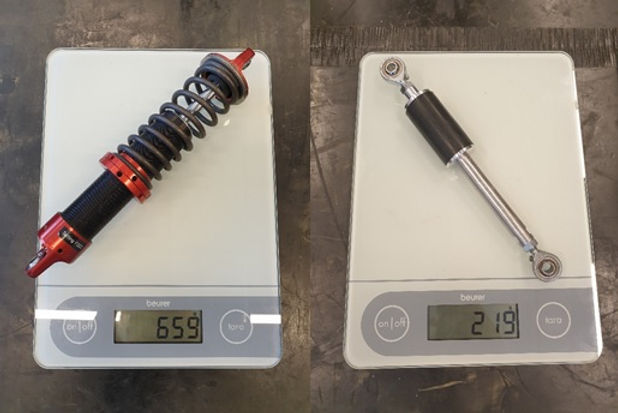
Another new development is that the team has replaced the commercially available spring unit previously used in the car with a custom-designed elastomer shock absorber.
Because the previous coil spring component had originally been designed for much higher loads, a transmission mechanism was required to artificially increase the load acting on it. This mechanism added extra weight. With the new shock absorber developed specifically for the vehicle, this additional mechanism can be eliminated, reducing the car’s weight further. Since the vehicle contains four of these components, the weight saving is multiplied across all four units.
It is already clear that the students found many opportunities to redesign and refine a vehicle that had previously been optimised to a very high level. Some modifications were introduced based on experience from previous years, such as the shade installed above the LiDAR sensor. This type of sensor scans its surroundings using numerous laser beams, and direct sunlight can reduce its measurement accuracy. A simple shade can help eliminate this problem.
This year we also updated our tyres. The reason is that the tread pattern on the previous tyres was not sufficient, and the judges did not consider them safe enough in wet conditions. The new tyres should not face the same criticism. To ensure complete compliance with the regulations, we also replaced the windscreen wiper, now using our own custom blade, and modified the five-point safety harness.
– added the team leader.
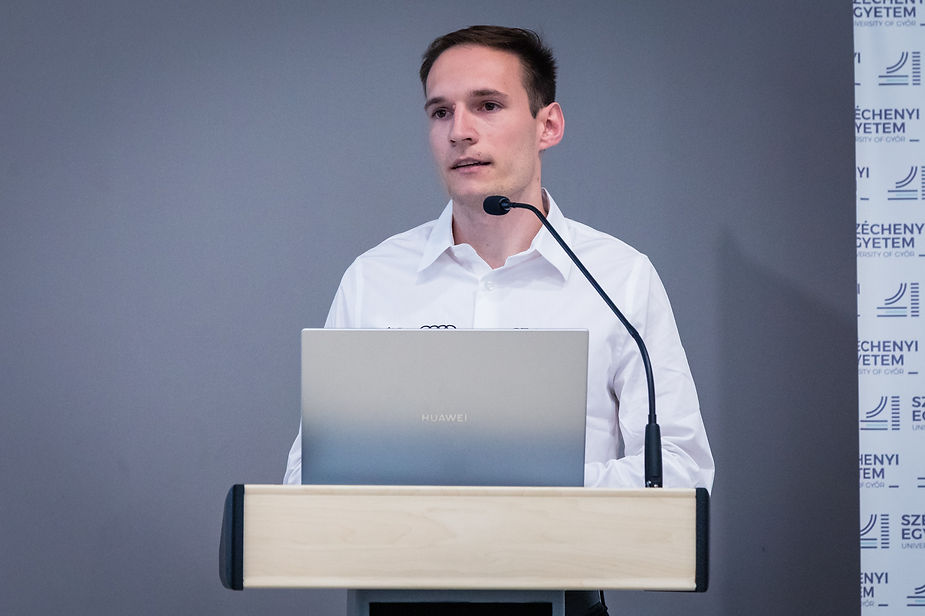
The developments of the Electronics Division were presented by division leader István Kecskeméti, who pointed out that although it is encouraging that power consumption has fallen below one watt, achieving further improvements will still require considerable work this year. The team’s goal is to reduce the vehicle’s energy consumption by further fractions.
We have been working on driving-cycle optimisation for years. This means that we can simulate both the track conditions and the vehicle’s driving characteristics, allowing us to design the ideal lap on a computer. Based on this, we can always aim for the best possible energy balance. The simulation is not perfect, because reality can never be reproduced completely, but the calculated driving cycle provides an excellent reference for the driver. The programme indicates whether the driver should accelerate or slow down at a given point on the track in order to achieve the best result. Previously, this interface ran on a tablet installed in the dashboard, but this year it has been replaced by a small LED display integrated into the steering wheel, which is not only more practical but also consumes less energy.
– explained István Kecskeméti.
Redesigning the autonomous hardware platform was another major challenge for the Electronics Division. This unit is responsible for operating all autonomous driving functions, including the sensors, with all related control and computing components integrated onto a single board. One of the advantages of this design is that the unit can easily be removed from the car. During conventional competition runs, this means the team does not have to carry the unnecessary weight or account for the additional power consumption. The sensors are used only when solving autonomous driving tasks and are not required during other events.
Since the vehicle detects the drivable route using a stereo camera when operating without a driver, it is very important that we have doubled the computing capacity by using a newer NVIDIA Jetson. Even more importantly, a dedicated device will handle video-based image processing. This means we do not have to share the capacity of the main control unit, because a separate piece of hardware will perform this task.
– said István Kecskeméti, explaining the development.
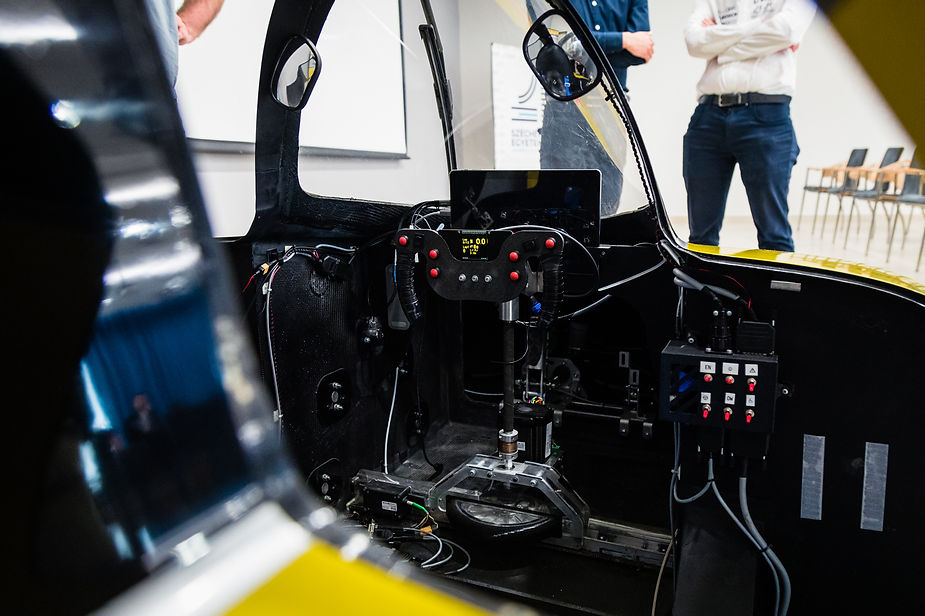
Regarding the autonomous driving functions, Miklós Unger, head of the Autonomous Division of SZEnergy Team, provided further details. He recalled that last year the team finished in an impressive second place in the autonomous driving competition. This year, victory is the goal here as well, but achieving it will be difficult for two reasons: first, the field is significantly larger and stronger than last year, and second, the organisers have changed the format of the competition. Instead of separate tasks such as obstacle avoidance, parking and slalom driving, competitors will face a single complex challenge consisting of several elements.
Once the system is started, the teams are not allowed to intervene until the vehicle reaches the end of the course. This makes the task considerably more complex and presents a major challenge for every participant, requiring extensive preparation.
We solve the autonomous driving functions on three levels and in three stages. Using a camera and LiDAR sensor, we perceive the environment and use a neural network to determine the drivable free space in front of the vehicle. During route planning, we calculate a trajectory, which is then passed to the vehicle by a path-following algorithm. It sends speed and steering-angle parameters to the control system, which ultimately directs the car.
– the division leader explained, summarising the background of the autonomous functions.
Source: SZE News – Márton Horváth