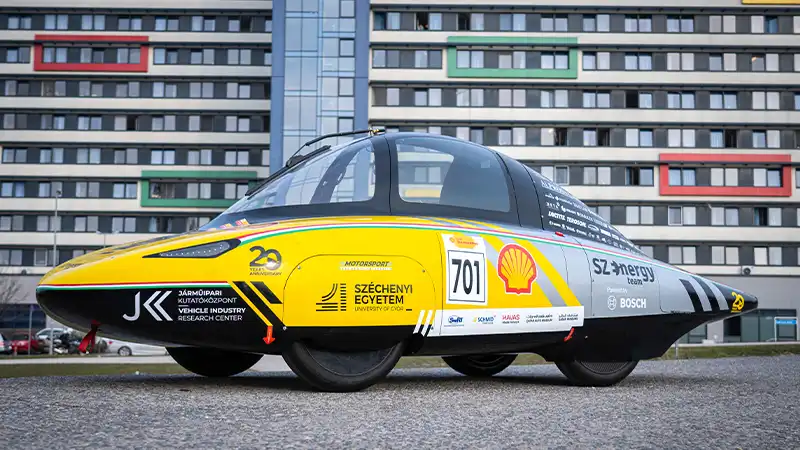
SZEmission
Weight: 95 kg
Efficiency: 332 km/kWh
Results achieved at the Shell Eco-marathon:
- 2026 – Kamień Śląski – 1st place
- 2025 – Kamień Śląski – 1st place
- 2025 – Kamień Śląski (autonomous driving) – 4th place
- 2024 – Nogaro – 1st place
- 2024 – Nogaro (autonomous driving) – 1st place
- 2023 – Nogaro – 1st place
- 2023 – Nogaro (autonomous driving) – 1st place
- 2022 – Assen – 1st place
- 2022 – Nogaro (autonomous driving) – 2nd place
- 2019 – London – 6th place
Our latest racing vehicle, the SZEmission, was completed in 2019 and has been continuously developed ever since. During the 2022 season, we achieved an energy-efficiency world record with the SZEmission at the Shell Eco-marathon in Assen. Our racing vehicle was capable of travelling 284 km on 1 kWh of energy.
At the 2023 competition, we improved this record even further, achieving an efficiency of 291 km/kWh. In 2024, we set another world record with an efficiency of 309 km/kWh, securing first place.
At the 2025 competition, we once again surpassed our previous performance, achieving an energy efficiency of 327 km/kWh and becoming world champions once again. At the 2026 competition, we set a new record with an energy efficiency of 332 km/kWh.
Thanks to its modified teardrop-shaped design, the vehicle has a drag coefficient of 0.1365, which is significantly lower than the 0.3 value of an average passenger car.
In addition to reducing aerodynamic drag, we place a strong emphasis on weight reduction. The vehicle features a monocoque carbon-composite body, resulting in a current race-ready weight of 95 kg.
The SZEmission uses LiPo batteries with a capacity of 350–530 Wh, while propulsion is provided by a PMS motor through a toothed-belt drive.
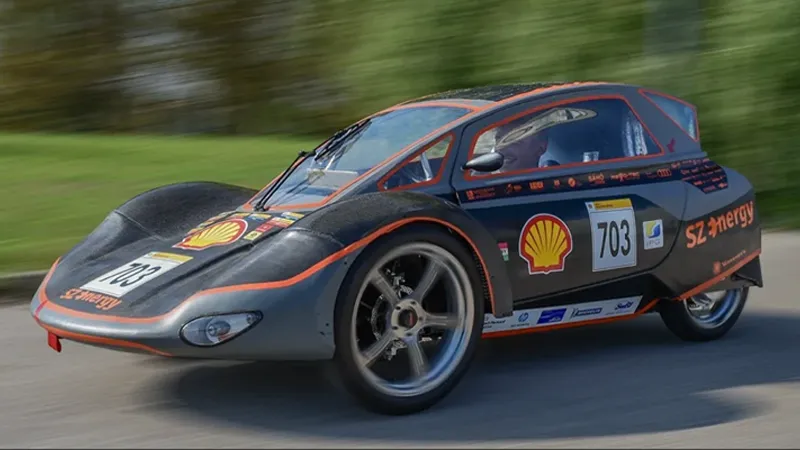
SZElectricity
Weight: 90 kg
Efficiency: 195 km/kWh
Results achieved at the Shell Eco-marathon:
- 2018 – London – 6th place
- 2017 – London – 4th place
- 2016 – London – 3rd place
- 2015 – Rotterdam – 3rd place
- 2014 – Rotterdam – 4th place
- 2013 – Rotterdam – 7th place
The SZElectricity served as the team's racing vehicle from 2013 to 2018, preceding the SZEmission in the Shell Eco-marathon. At the time of its construction, the vehicle weighed 90 kg.
The vehicle featured an aluminium frame combined with a carbon body. Propulsion was already provided by a 250 W PMS motor. A 0.65 m² solar panel was mounted on the roof of the SZElectricity.
In addition to the monocrystalline solar panels, 48 V Li-ion batteries supplied the vehicle with energy. For the 2015 competition, the vehicle underwent major further development.
In 2016, we introduced an optimized steering knuckle, a 3D-printed rack-and-pinion steering system, and a custom-developed outer-rotor PMS motor.
For the 2017 and 2018 seasons, optimization and weight reduction became the main development priorities.
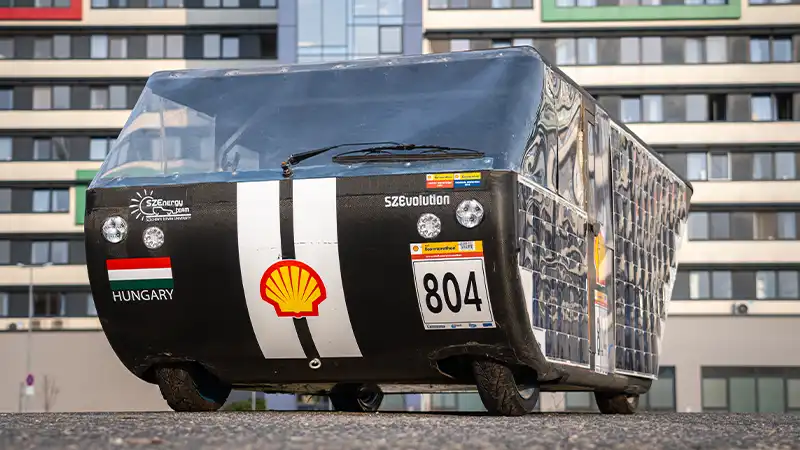
SZEvolution
Weight: 138 kg
Results achieved at the Shell Eco-marathon:
- 2012 – Rotterdam – 2nd place
- 2011 – Lausitz – special award
- 2010 – Lausitz – 1st place
The SZEvolution served as our team's alternative-powertrain vehicle from 2010 to 2012. At the time of construction, its total weight was 138 kg.
Similar to the SZElectricity, the concept vehicle featured an aluminium frame and carbon body, powered by two 1 kW BLDC motors.
The vehicle was equipped with 7 square metres of monocrystalline solar panels with an efficiency of 18.5%.
The SZEvolution was the first Urban Concept vehicle in the Shell Eco-marathon to complete the competition with a positive energy balance.
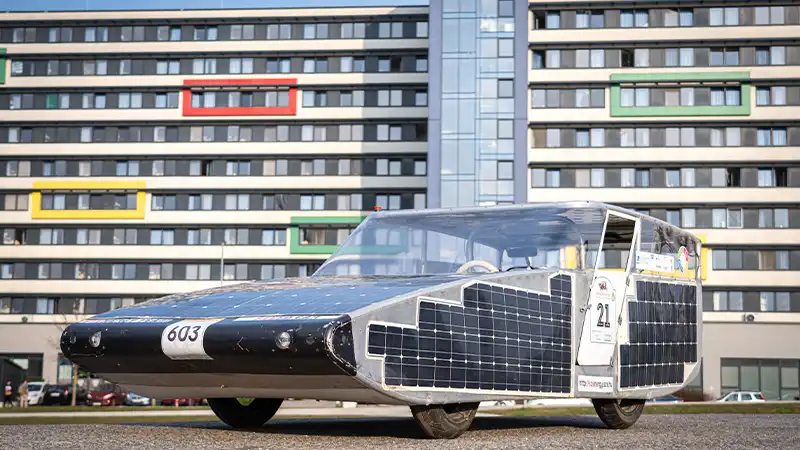
SZEnergy Car
Weight: 152 kg
Results achieved at the Shell Eco-marathon:
- 2009 – Lausitz – 1st place
The SZEnergy Car was built in 2008 and competed with our team until 2010.
At the time of construction, the vehicle weighed 152 kg and featured an aluminium frame and carbon body.
Propulsion was provided by one 2 kW BLDC motor, powered by 7 square metres of monocrystalline solar panels with an efficiency of 17.5% and one 48 V Li-ion battery.
The SZEnergy Car was our first racing vehicle to achieve the best energy balance in the competition.
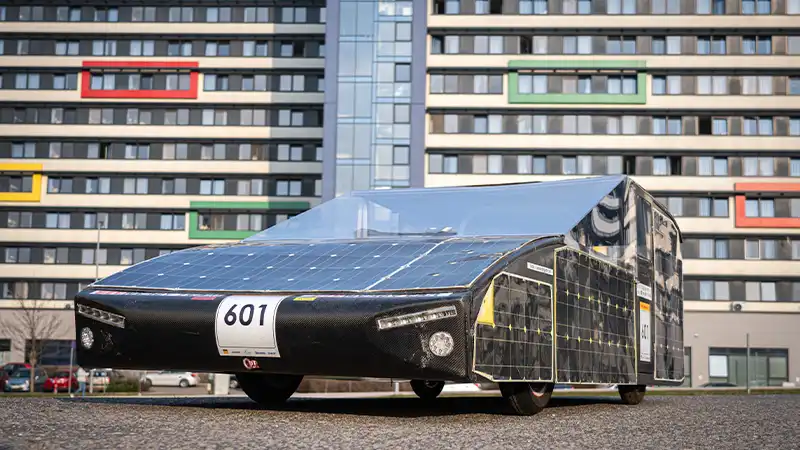
SZESOCAR
Weight: 149 kg
Despite the weather, he was the only one to complete the 14-km circuitResults achieved at the Shell Eco-marathon:
- 2008 – Nogaro – 1st