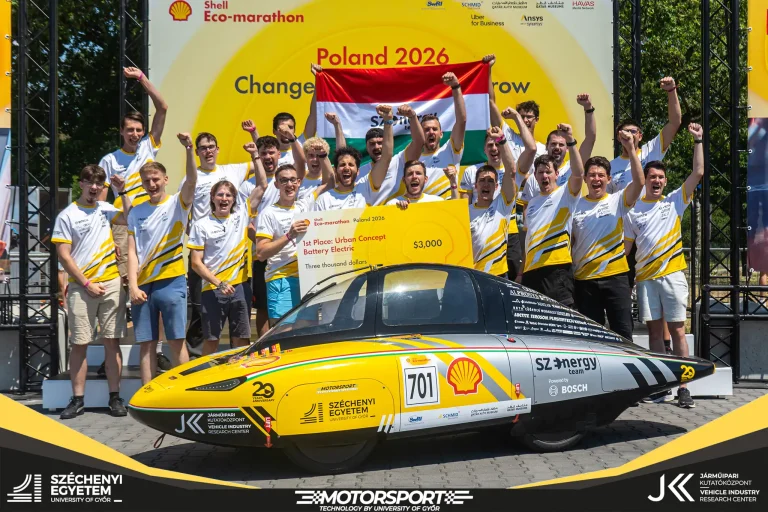
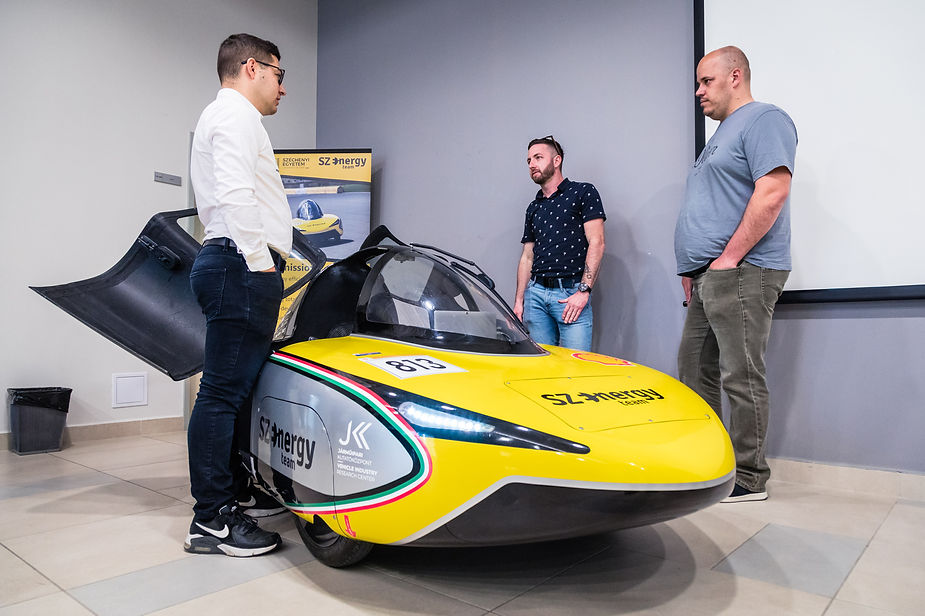
In 2005, a group of mechanical engineering students at Széchenyi István University decided to seek challenges beyond the classroom and, under the guidance of lecturer Dr Zoltán Varga, began building an alternatively powered vehicle for the Széchenyi Race. The rest is history: competing under the name SZEnergy, the team won the solar-powered category of the Shell Eco-marathon in 2008 and again in 2010. After several podium finishes and a change of category, the team returned to the top in 2022, setting a world record to win the Urban Concept category — a feat it has since repeated three more times.
To mark the twentieth anniversary of its foundation, the team complemented its traditional design freeze event with a look back at its history and showcased all previous generations of its vehicles, together with its collection of trophies.
“The fundamental mission of the university is to prepare its students for successful professional careers” – said Professor Dr Ferenc Friedler, Rector and Vice-President for Academic Affairs of the university, in his opening remarks. He added that the team not only continues to remain at the forefront, but also achieves significantly better results than its rivals, demonstrating that it possesses special expertise and an ability to continuously innovate. “Perhaps this is the secret ingredient of its success” – he noted.
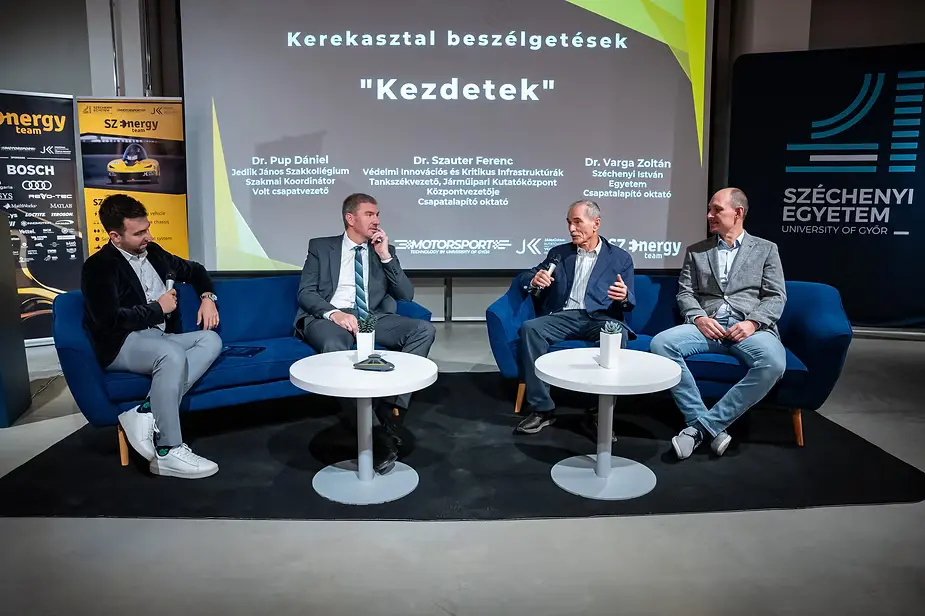
The first round-table discussion focused on the period when SZEnergy was founded. “Zoltán Varga was the first at our university to introduce the ‘learning by doing’ methodology, recognising that, on the one hand, practical experience is one of the best ways to deepen theoretical knowledge and, on the other, that a competitive environment provides a natural incentive to expand that knowledge. At the time, as a young lecturer, I helped the core group that eventually developed into SZEnergy” – recalled Dr Ferenc Szauter, Head of the Department of Defence Innovation and Critical Infrastructure and Director of the Vehicle Industry Research Centre.
“After the Széchenyi Race, I thought we should move on to the international stage. That was when I discovered the solar-powered category of the Shell Eco-marathon. We could never have imagined that we would win the competition at our very first attempt in 2008. It gave the team an enormous boost.”
– noted Dr Zoltán Varga.
“In 2010, we managed to repeat our success from 2008, but then the solar-powered category was discontinued, and we lost some momentum. We entered the Urban Concept category with a battery-electric vehicle. It took many years of persistent work and countless developments before the team reached the top again in 2022” – added Dr Dániel Pup, professional coordinator at the Vehicle Industry Research Centre, who, as one of the founders, continues to actively support the team’s work.
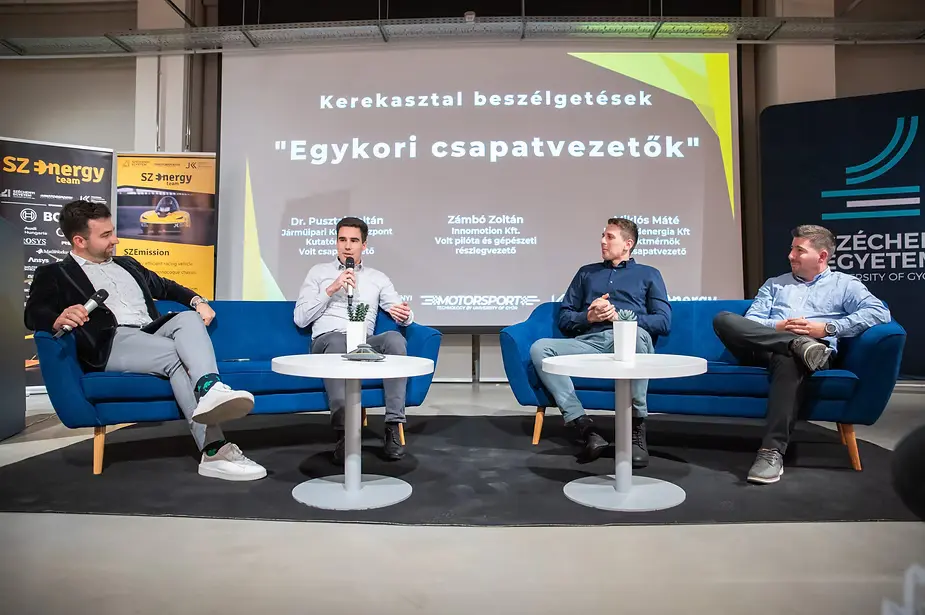
The next panel discussion focused on the recent years of SZEnergy Team and presented the development process that led to its successes. This was illustrated particularly well by Zoltán Zámbó, the team’s former Head of Mechanical Engineering and driver, who recalled that initially two multimeters were simply attached to the side of the car, requiring the driver to monitor consumption and charging data manually. Over time, continuous development gradually reduced the workload placed on the driver.
“The biggest leap came with the debut of the vehicle named SZEmission in 2019. We are still competing with a modified version of this vehicle today.”
– explained Dr Zoltán Pusztai, research engineer at the Vehicle Industry Research Centre and former team leader.
“We have also made enormous progress in terms of infrastructure over the years” – said former team leader Máté Miklós, highlighting the importance of the university’s support. “The Multifunctional Dormitory was completed in 2017, where we were given a laboratory, followed later by equipment and a range of tools that enabled us to build a vehicle with a monocoque body. The university’s supporting role is therefore crucial, but we would not be able to achieve these results without our other sponsors and partners either. Just think of the extensive machining, testing or even travel costs involved, as we often had to travel to countries such as the United Kingdom and the Netherlands” – he explained.
Following the discussions, the team presented its developments for this year. From a mechanical engineering perspective, the most important of these is the implementation of regenerative braking, allowing the vehicle to recover and reuse energy generated during braking. Another development is the replacement of the aluminium pedal box with a carbon-composite version, which improves the vehicle’s reliability while also reducing its weight. István Madarász, Head of Mechanical Engineering, presented these developments.
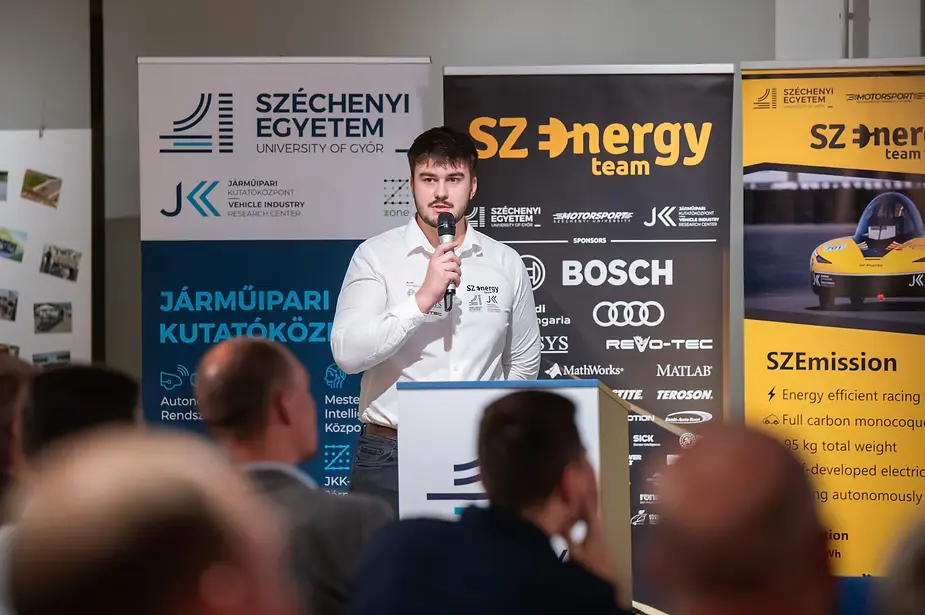
“Our driving optimisation software has played a major role in our successes over recent years, as by modelling the vehicle and the track we have been able to determine the speed profile corresponding to optimal energy consumption. This season, we plan to develop it further so that the vehicle dynamics model can run live on the vehicle while driving, allowing us to achieve an even better energy balance than before.”
– explained András Timár, Head of Electronics. He also outlined several other developments, including the planned replacement of the lights and the implementation of an online telemetry system.
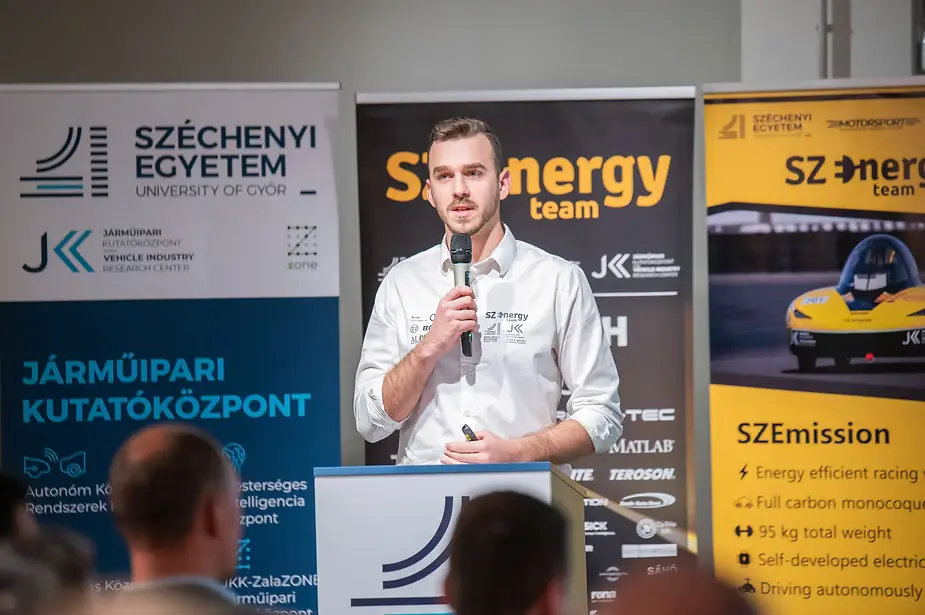
The autonomous, or “self-driving”, division is responsible for implementing the vehicle’s autonomous functions. The team aims to replace the existing hardware system, which could reduce energy consumption by as much as 25 percent while also resulting in a panel that is easier to install and maintain.
“In terms of software, the most important task is the development of our road segmentation model. At present, we only detect drivable and non-drivable road surfaces, but in the future additional classes will be introduced, enabling us to detect the edge of the track and lane markings, which will allow for more precise route planning.”
– emphasised Szabolcs Halir, Head of the Autonomous Division.
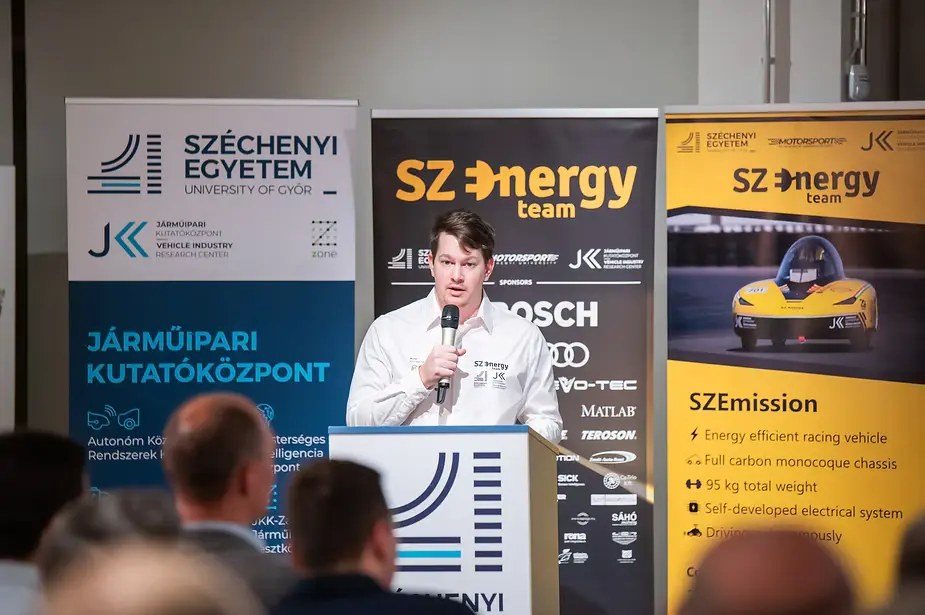
Veronika Végső, a member of the Marketing and Management Division, said that the team had an excellent year on social media, reaching large audiences with its posts on Facebook, Instagram and TikTok.
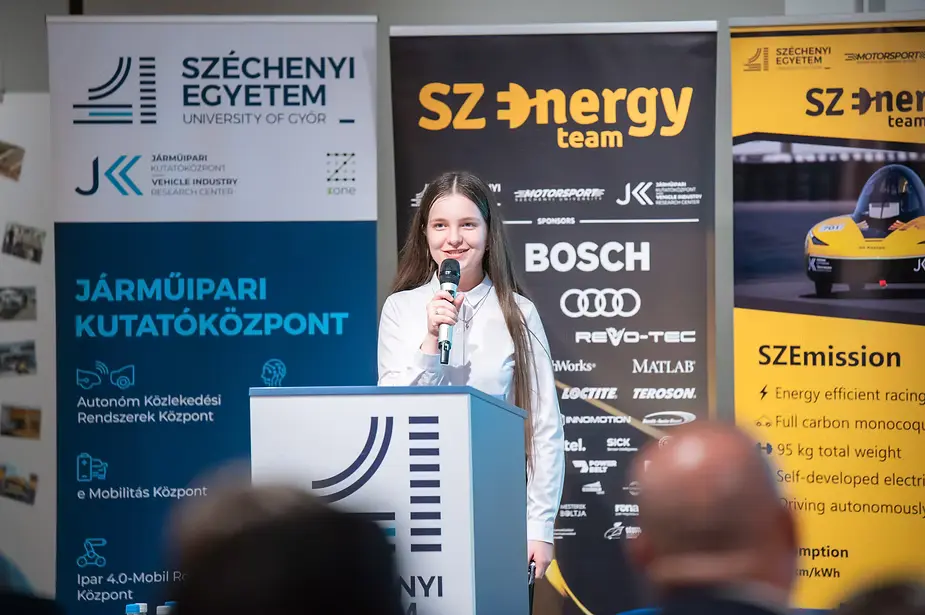
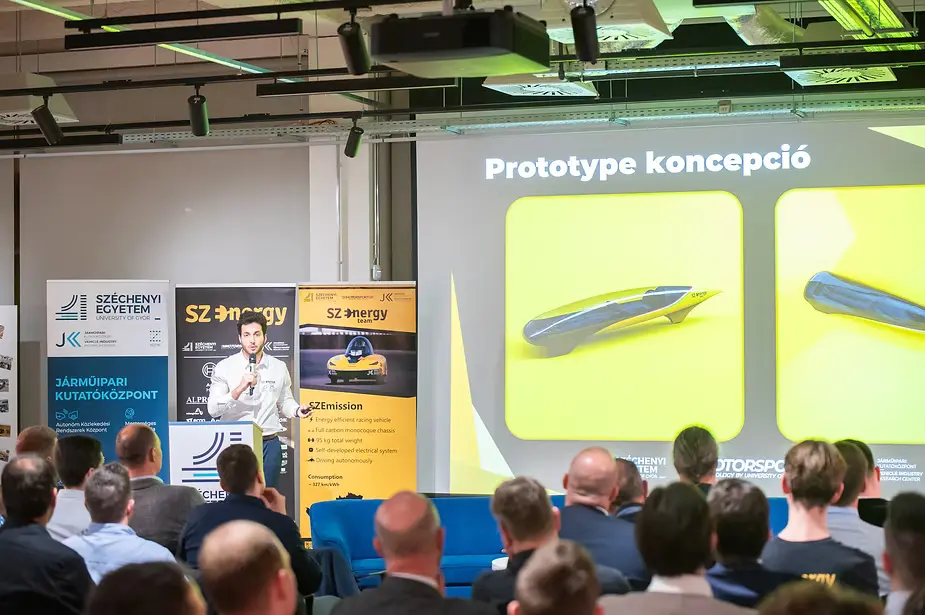
The announcement defining the team’s new direction was saved until the end of the event. Team leader Bence Novák explained that they are looking for new challenges to support the further professional development of team members. A change in the Shell Eco-marathon rules provides an excellent opportunity, as teams are now permitted to compete in two categories. Taking advantage of this, alongside its existing Urban Concept vehicle, the team has begun developing a prototype vehicle that will have to comply with a very different set of regulations.
“This car will be much more aerodynamic, with three wheels, and the driver will operate the vehicle in a reclined rather than seated position. We will have to design the vehicle to be even more efficient, and we also face a complex challenge from an electronics perspective. Our plan is to compete with this car at the Shell Eco-marathon in 2027.”
– concluded the team leader.
Source: Széchenyi István University